Hello and welcome back to HallyuTones – always focused on sound, stage and substance.
As long time readers of the site may know, October is Pride Month in South Africa and the end of October is when some of the biggest Pride events in the country happen. Oftentimes, the existence of LGBTQ+ people and their stories is used to capture attention but without giving full attention to the weight that they hold. For this reason, last year I took a look at some Seemingly Sapphic K-pop songs and their lyrical content. This year, we’re talking directly to the LGBTQ+ community in South Korea and learning from their stories.
The internet is an interesting place. As frustrating and scary as it can sometimes be, it is also one of the main methods that people who aren’t free to live openly can gather, learn, share and commune with each other. It is in this way that I first saw and heard about Les Heroes.
In our interview with Ban Seolhee, I discussed the vast variety of spaces that artists can find to do their work. There’s the Jihadol space, the online space, but also, the dance space. While the demand for K-pop Dance Academies has exploded in Korea and beyond, an extremely popular concept for international fans is that of “K-pop in Public”. This is a type of content that involves dance crews and cover groups putting on full performances of all types of Korean songs in public settings.
While it may feel like there is nothing particularly groundbreaking about this, it’s always worth it to remember that hobbies and professions that are mainly enjoyed and done by women or perceived as too feminine, often evoke disdain in the general public. K-pop performances from dance crews and other cover groups in public spaces are not only about showing off skills and talent, but also about reclaiming space and time to exist freely.
These performers do receive their fair share of backlash and disturbances. However, the awe experienced by the audience both in person and online, makes up for it in many ways.
As we welcome in an era of idols who are out and proud such as JustB’s Bain, the recently debuted NewKin featuring former QI.X members, and XLOV who are adamant in protecting their (anti)label of genderless group, it becomes interesting to see how many groups have walked this path before, and what’s coming next. More importantly, we look to how it is that we can support and encourage the existence of these groups and their longevity.
Les Heroes represents a fight being fought globally for the dignity of LGBTQ+ people and artists, but they are also just young women who love dancing and want to share their talent and interests with the world.
Here to share some insights on being Queer in Korea, please welcome Les Heroes:
Interview:
- Hello and welcome to HallyuTones. Please introduce yourself to the readers.
Hello! We are Les Heroes, a lesbian K-pop performance group based in South Korea. Having started at the 2019 Seoul Queer Parade, we use K-pop dance performances to express lesbian and queer pride, freedom and love.
We strive to create a parade that is more than just a performance—one where participants can all sing, shout and run about together, celebrating each other’s existence to their heart’s content.
- Can you explain what kind of performance group Les Heroes is?
We strive to create performances that bring participants together through the universal appeal of K-POP. We utilise K-POP music from different eras that can be enjoyed by people of all ages, couple dance performances befitting the name ‘Les Heroes’, and a concert-style format that allows everyone to sing along together.
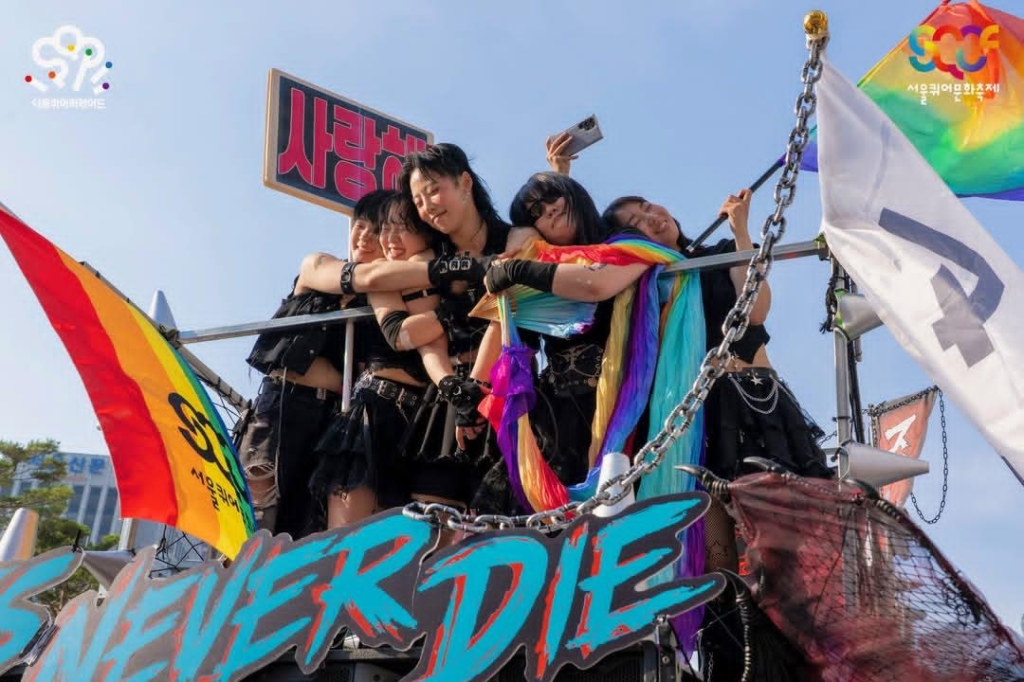
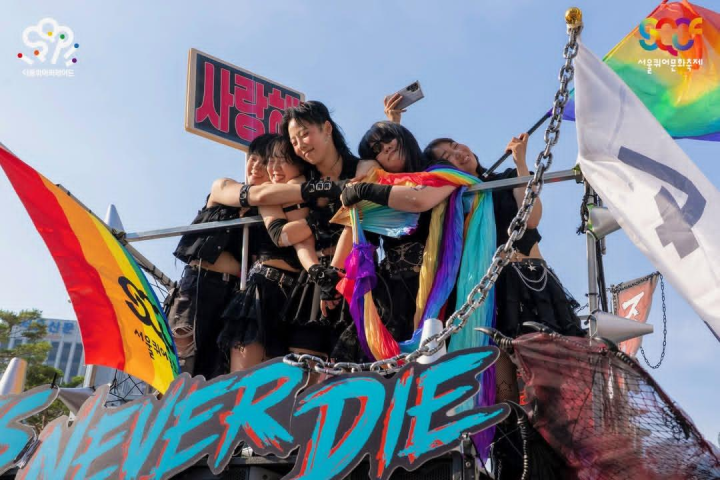
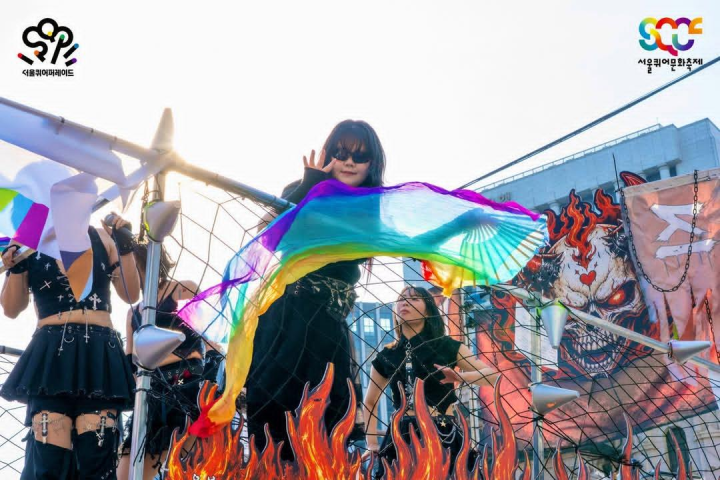
Reimagining the overall concept—including the parade floats and costume designs—each year is also a key strategy for making our performances stand out. We offer playful reinterpretations of existing characters and tropes—such as Les Hero, Power Les Girl, Les Max and Les Never Die—to weave a narrative, whilst striving to fulfil the parade’s purpose of raising the visibility of the lesbian community.
- How was the name of the team decided? Were there any other options for the name?
Our name is ‘Les Heroes’, a combination of ‘Lesbian’ and ‘Heroes’. When people think of heroes, they often picture extraordinary beings who save the world, but our idea of a hero is slightly different. We believe that ordinary people—those who live and love as they truly are, and who support the freedom of others—can also be heroes. We also wanted to create stories in which women are the protagonists and heroes of their own lives. Therefore, our message is: ‘Everyone here is a hero!’
- What initially brought you all to the dance studio?
Ahyeon : I’ve wanted to try K-pop dance since I was young, but I never had the chance while focusing on my studies. After starting my job and moving to Jeonju, I finally had the time and financial freedom to pursue it.
Also, seeing the rainbow icon on Eunji’s Instagram made me feel like this would be a warm, inclusive space, which ultimately pushed me to join!
- Les Heroes is an openly LGBT+ dance and performance team. How has the team’s attitude towards performing changed with the debut of other openly Queer acts like QI.X, and XLOV that break gender boundaries?
Compared to 2019, when we first started out, I feel that the ways in which gender and identity are expressed within K-pop are gradually becoming more diverse.
It is a very welcome change to see the emergence of artists such as QI.X, who openly embrace their queer identity; artists like Lara and Megan from Katseye who speak confidently about their identity; and artists such as XLOV, who are breaking down the boundaries of gender expression.
Although attitudes are already changing significantly, I hope that, moving away from the gender binary and heteronormativity, more artists in the future will be able to express themselves without having to hide or restrict who they are.
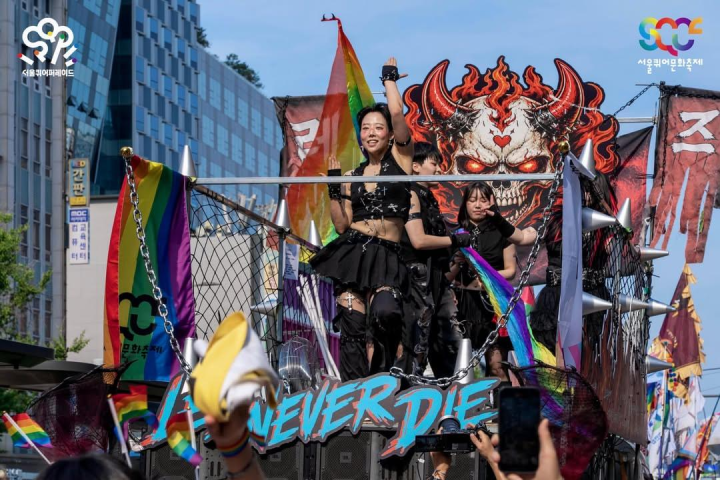
- What is something that international fans may not know about the LGBT+ community in Korea?
South Korea’s Queer community is far more diverse and vibrant than people might think. Whilst discrimination against sexual minorities and institutional barriers still exist in Korean society, at the same time, there are people who have long been connecting with one another and creating their own unique culture.
In particular, Korea’s Queer Culture Festival is not merely a march, but a unique festival culture where music, dance, performances, humour and political messages come together. There are also many moments when people affirm each other’s existence by singing and dancing to K-pop together.
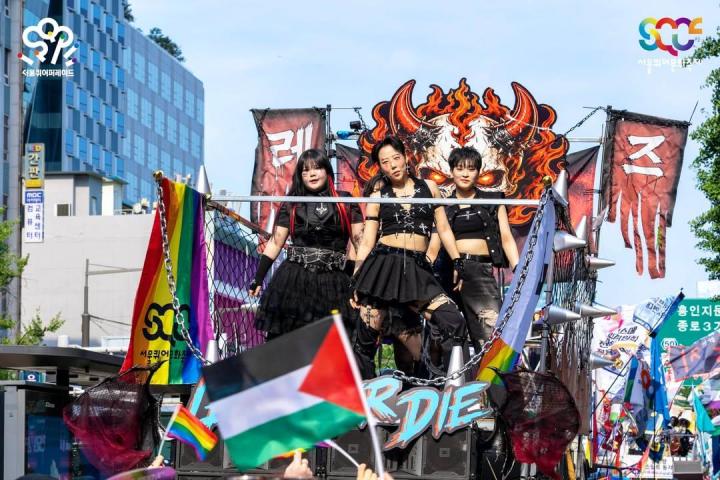
Furthermore, Korea’s Queer culture is not confined to Seoul. Across various regions, people are coming together, creating their own festivals and sustaining their communities. Even in the face of oppression and discrimination, Korea’s Queer community unites all the more, having fun, loving one another and forging their own lives.
- Who are your favourite Queer Korean icons?
Ahyeon: First, I’d mention Seoyeon from the recent Korean lesbian dating show ToGetHer (너의 연애). She’s introverted, a bit mysterious, and so beautiful—I find her really captivating.
My second icon is Les Heroes—my dance team! To me, my teammates are always the coolest, most wonderful heroes, and I love them so much.
- Yerim: Both you and Eunji present yourselves in ways that many within the idol and K-pop system consider “unconventional” for women similar to MIYA of GWSN (궁원소녀) and Moonbyul of MAMAMOO (마마무). What words would you use to describe your style and what do you think is the most unique feature?
If I were to describe my style, I’d say it’s ‘free, confident and distinctive’. I don’t believe there are any set criteria for whether clothes or style are masculine or feminine in the first place. It’s important to freely choose what I personally find stylish. Especially on stage, I think you’re at your most attractive when you find a way of expressing yourself that suits you well and present it with confidence. Rather than insisting on a particular style just to stand out from others, I feel my own style has simply developed as a result of choosing what I like.
- Ahyeon: What was the first performance where you felt right at home with the Les Heroes members? What made this moment special?
To be honest, that feeling of truly feeling at home came quite recently. It was at the 2026 Seoul Queer Parade, when we were all jumping around and singing Girls’ Generation’s ‘Forever 1’ together. As we sang out the lyrics ‘Let’s last forever’, we all hugged each other. We can’t promise eternity for every relationship, but in that moment, I was certain that all of us would remember that exact second forever.
K-pop often thrives on fixed, polished images, and we aren’t completely free from those expectations either. Ironically, it’s amazing how this very K-pop is what brings us together and allows us to feel so free. True to our team’s identity—defined by freedom, honesty, love, and solidarity—we embrace diverse K-pop performances to express ourselves fully. I believe these shared moments will become our greatest strength whenever we face challenges simply for being who we are.
- Eunji: If you could only choose two songs to perform for the rest of the year with the team, which would you choose and why?
The first is IU’s ‘Good Day’.‘Good Day’ is a song so famous for its ‘triple high note’ that virtually everyone in the country knows it.
It was a song where people would change the lyrics from ‘I have an oppa’ to ‘I have an unni’ and sing along, and where you could feel a sense of liberation by belting out the triple high note to your heart’s content in the street.
Another highlight of our vehicle parade is the performances where lyrics featuring men or ‘oppa’—such as in Girls’ Generation’s ‘Oh’ or BLACKPINK’s ‘BOOMBAYAH’ are rewritten to feature women or ‘unni’ during the parade.
The second song is Baekho’s ‘Elevator’. The original song was by Park Jin-young, but Baekho remade it and performed a passionate couple’s dance on stage.
As this is a lesbian float, it’s a song where you can see the chemistry between the members and a passionate lesbian performance.
You can also see photos of the kissing performance on our Instagram feed.
Given the significance of visibility inherent in a parade, this is an opportunity to directly showcase lesbian love; and for participants, watching sexy performances or tracks brimming with sexual tension between members—witnessing sexual intimacy, seduction and expressions of love between women rather than between men and women—allows them to cheer and enjoy themselves to their heart’s content. For this reason, I believe it is the Les Heroes float’s signature performance.
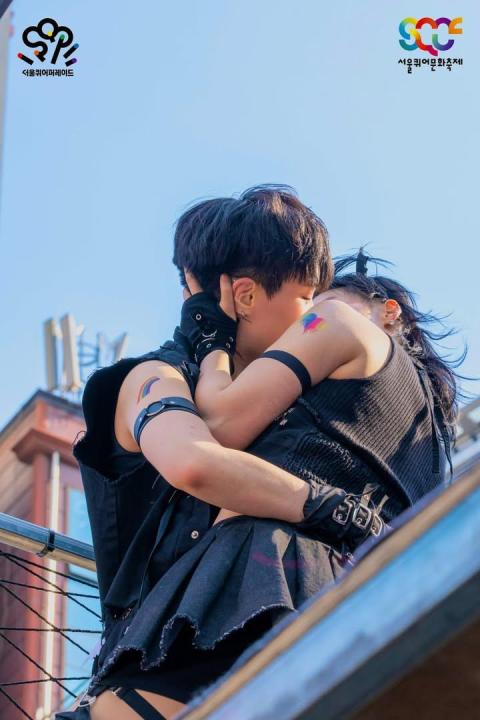
- If you could explain why Les Heroes is important to someone who has never seen you before, what would you say?
I don’t think that simply being queer, or taking part in a Queer Culture Festival, necessarily creates a sense of connection.
Even if you visit queer spaces, use community apps or take part in a Queer Culture Festival, I believe you ultimately need opportunities to connect with other Queer people. I believe the Les Heroes vehicle is precisely that ‘link’.
Anyone from Korea will have experienced a sense of connection with others through K-pop at various moments in life—be it during their school days or in a karaoke bar. Through the music blaring from the Les Heroes van, which awakens the joy embedded in our DNA, and through the experience of instinctively shouting in unison and jumping up and down, a beautiful moment is created where we can feel our sense of connection directly and viscerally.
In this way, as we check in on one another’s well-being and reaffirm each other’s presence, feeling that we are breathing together on this earth at this very moment,
I believe this can serve as a springboard for the courage to affirm our own existence.
- What song do you think best captures the energy of the team?
Ahyeon: I’d choose ATEEZ’s ‘BAD’—even though I didn’t perform in this particular stage myself! In Korea, this track was popular for showcasing a very intense, traditional sense of ‘masculinity.’ But seeing our female members with all different body types take on that song and completely own it was so beautiful and powerful. To me, Les Heroes’ energy is all about expressing whatever version of ourselves we want to be, without limiting ourselves to rigid ideas of femininity or masculinity—and doing it with incredible skill and confidence.
- Being out and proud as an LGBT+ person in any part of the world can sometimes feel lonely. What are some things that remind you all of the love and support of your loved ones?
I feel it every time I go to Queer Parade. Whenever I’m there, I’m deeply reminded that ‘there are so many of us.’ Sometimes it feels like we’re alone, but in reality, we are everywhere. The moments we gather and connect during the parade fill up the empty spaces in my daily life with so much warmth and energy.
- What are some key things for international fans of Korean media to remember about the LGBT+ community in Korea?
It is about showing your support so that a wider variety of Queer content and characters can appear.
Ultimately, it is the fans who influence the media industry, so please continue to show your enthusiastic support (which you are already doing in great measure) for works and characters that portray diverse gender identities and sexual orientations, and provide feedback via social media or other channels to production companies and broadcasters via social media or other channels.
The low level of acceptance of Queer issues in Korea is largely due to an atmosphere that tells people to ‘stay in the shadows’ or ‘keep it amongst yourselves’, so I believe that visibility and openness in various forms are needed above all else.
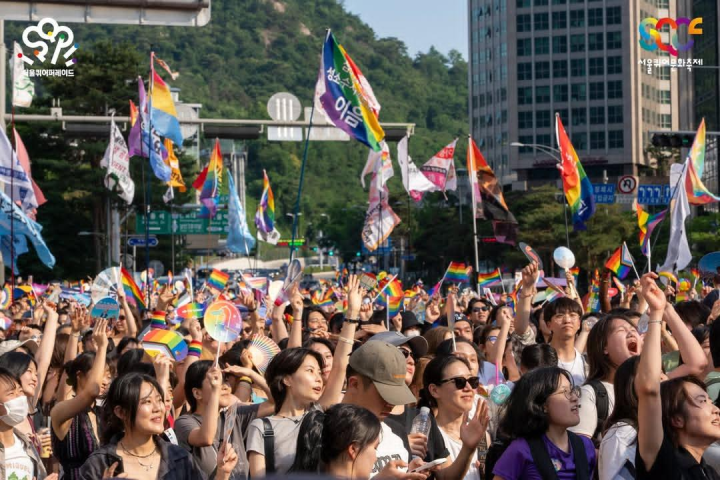
- What are some things that you absolutely love about being lesbians?
Ah: I love that we can freely open up and talk about feminism together! It creates such a deep level of understanding and connection.
Yujin: Women are just brilliant! (Laughs) I love and admire amazing women, and I love being loved by them in return. And I love hanging out and dancing with friends who share that sentiment. There’s so much joy in living as a lesbian.
Eunji: What I like most is that it makes me rethink the rules of relationships that were previously taken for granted. It makes me question who should play which role, what love should look like, and whether we really have to form relationships in a specific, predetermined way. Being a lesbian doesn’t automatically set me free, but for me, it’s been a crucial turning point that has allowed me to choose and define my own life and relationships.
Yerim: I really love the energy that’s created when lesbians get together.
Those moments when we talk about the women we like, cheer each other on, and dance and have fun together. For us, being a lesbian isn’t just a word that explains who we love; it’s also a point of connection that allows us to meet new people and create diverse cultures.
- Lastly, what message would you like to send to HallyuTones readers and fans of Les Heroes?
First of all, thank you so much for taking an interest in us, a South Korean lesbian K-pop performance group! We are ordinary people going about our daily lives, but we believe that when we dance and sing together, we can become heroes who are freer and more wonderful than anyone else.
What we aim to convey through our performances isn’t just some grand message. We want to show that anyone can live as they wish, and that simply living a joyful life with the people you love is wonderful in itself. We also think it’s truly marvelous that, by singing and dancing together to the music we love, people living in different places can connect with one another.
We look forward to the day when we can dance and sing in the same space with fans from all over the world.
We’re always open to parade bookings, so please do get in touch 🙌
Until then, wherever you are, be your true self, love to your heart’s content, and live life to the fullest.
Les Never Die!
Let’s sing, dance and love
to our hearts’ content! ❤️🔥🌈
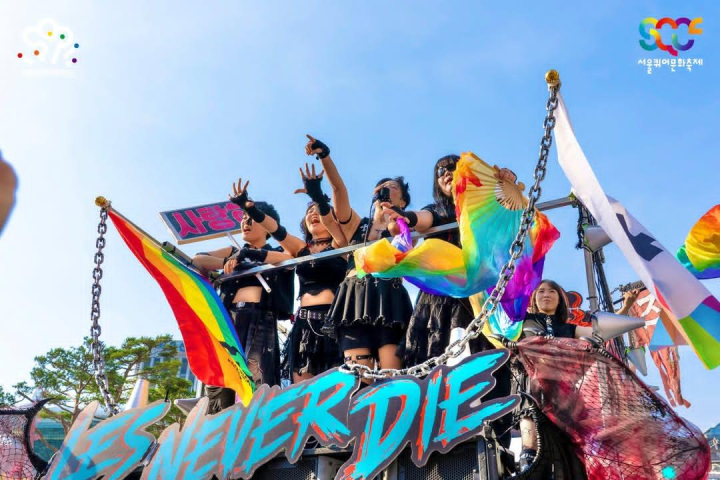
It’s extremely easy from the outside of Korea to speak abstractly about its people and the performers we see on stage, especially when the word ‘idol’ helps us obscure their humanity. Beyond the stage and beyond the gimmicks of the system, are real people sharing their capabilities, their curiosities and their love of art with us all.
As mentioned by the members of Les Heroes, visibility is an important aspect of ensuring support for LGBTQ+ people and performers especially in a space that is still socially hostile. When we speak about humanising the idol experience, it means that even when we see their performances and actions through our own lens, we must be aware that our actions have consequences in their lives and our own, and our priority must be safety and agency first and foremost.
If you have been on TikTok recently you may even have seen Korean Drag Queen Hurricane Kimchi’s ongoing series of ‘Coming Out until Korea has an Anti-Discrimination Law’. What this means for acts like Les Heroes and many more, is that simply encouraging people to live free and to care for others, is to advocate for a better, safer world, all while singing and dancing and loving to our heart’s content.
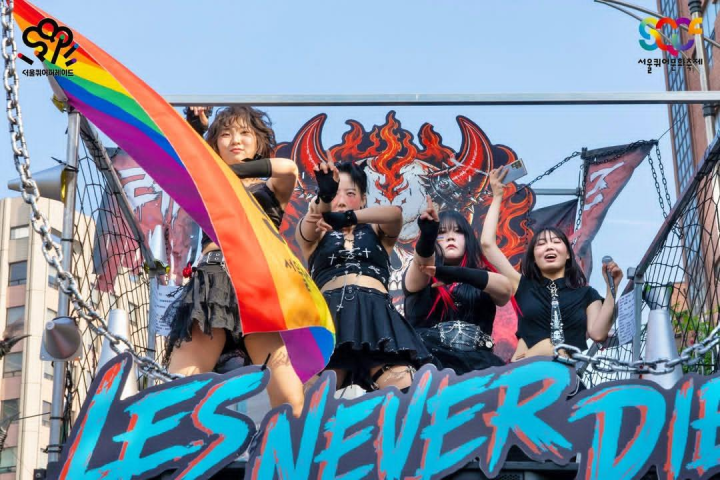
To support the members of Les Heroes, make sure to follow them at the links below:
Instagram: https://www.instagram.com/les_heroes2026/?hl=en
Twitter/X: https://x.com/les_heroes
YouTube: https://www.youtube.com/@레즈히어로즈


Leave a Reply