
Hello and welcome back to HallyuTones — always focused on sound, stage and substance.
Sappho of Lesbos. For enthusiasts of literature and active participants of alternative culture, that name may ring familiar. Sappho was a Greek poet from the Isle of Lesbos, and as a result of her life’s work, we now have words to describe love as it pertains to women and gender diverse people. The term Sapphic is rooted in the artist’s lifelong attraction to women and her dedication to writing about these experiences and the other women around her who shared similar feelings. In other words, it is an umbrella term. Much like Women Loving Women (WLW) or Queers Loving Women that allows us to approach love and attraction as abstract subjects through the female gaze.

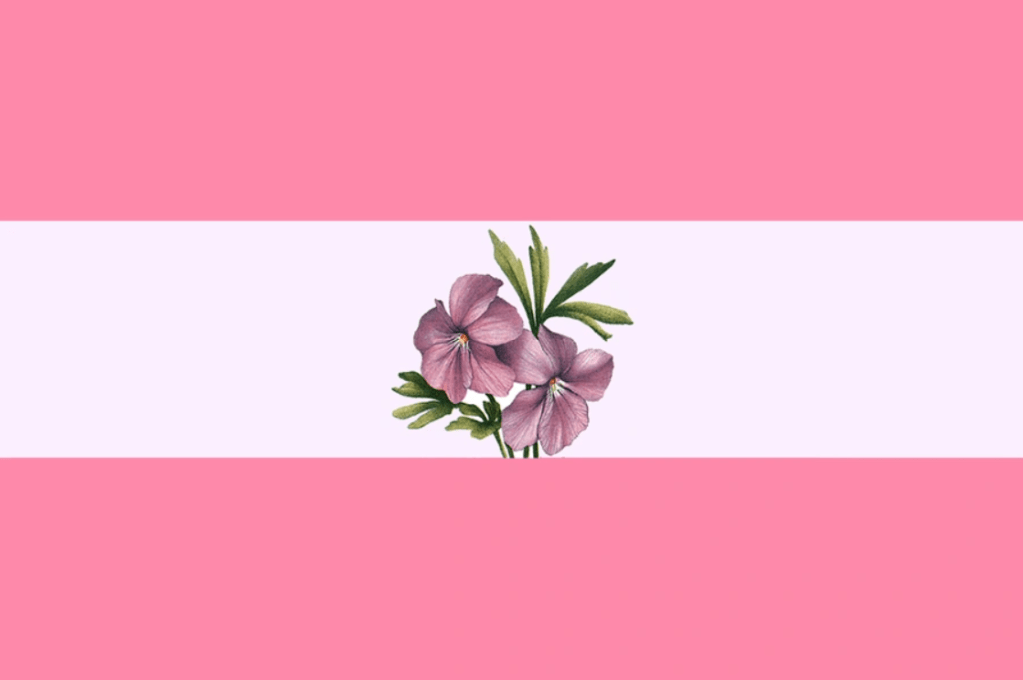
Sapphic / WLW / SGA Women Flag by Cayla, with a botanical illustration of violets
Seeing as it’s Pride Month in South Africa, and International Lesbian Day was marked on October 8th, today’s piece will highlight some Sapphic songs across the Korean music industry. Many fans of K-Pop spend their time finding queer-coded lyrics and moments in music videos, and this can be fun. However it is also important to realise that these songs and videos do not exist in a vacuum and oftentimes are not just queer-coded, but inherently Queer in their subject matter and presentation.
Khan – I’m Your Girl
We’re starting off strong with the one and only iconic single, I’m Your Girl?. Many lovers of WLW themed songs in K-Pop automatically add this song to their playlists when they go searching for something with Sapphic themes. The music video follows the two members as one of them navigates their hidden feelings for their friend.
The lyrics also mirror much of the internal conflict that many people have when they’re reaching out to someone who they’re not entirely certain loves them back equally. With the combination of gender neutral lyrics as well as visuals that present unrequited love, the song speaks to a formative experience of many LGBTQ+ youth: falling in love with someone who may never see you in the same way.
In the video we see a girl and her boyfriend holding hands. She keeps looking back at who we can assume is the true object of her affections because at the exact moment she looks back, member Minju’s voice breaks through with desperation. She sings “It’s awkward right now; We weren’t drunk”, a baffled rumination that leads us to believe the two women shared a moment that was not just platonic.
Further on in the lyrics, we read that the back and forth between love confessions and withdrawals from Euna’s persona is a daily occurrence. A perfectly written dialogue accompanied by the compositions of Black Eyed Pilsung (one of Korea’s greatest production duos). While the group only released this track and thus we are unable to connect this song to a deeper discography, this one song encompasses a whole range of emotions in its visual, lyrical content.
The song perfectly captures the ambiguity, and the determination to be more than just a footnote in someone’s love story as a LGBTQ+ closeted person.
Tri.Be – Kiss
Tri.Be is a group whose career has given us some of the most addictive tracks from K-Pop’s fourth generation. The most well-known amongst them being Kiss from their third single album, LEVIOSA. The song garnered a lot of attention for its provoking lyrics and perfect suitably for social media edits.
This song focuses on the actions of people who want to explore their attraction, this time we’re talking about a first kiss. The catchy rap section captures the confidence of someone going for what they want, aware of their own charm. Throughout the song, some lyrics read almost like the mental monologue of someone who has yet to take that first step with someone they like: Hesitating between going ahead with it, and surrendering to their own desire.
The person on the receiving end of the rap’s teasing seems to have been crushing quite obviously because the key point of the song is the nursery rhyme repurposed, “All my girls sitting in a tree… K-I-S-S-I-N-G”. While it’s easy to dismiss this addition as childish, it’s important to remember that not many people have had the luxury of being able to comfortably express their Sapphic attraction as kids.
This bit serves to make the concept of approaching an objectively intimidating moment with mirth and excitement instead. Overall, the song highlights both the tension that pursuing same gender attraction brings, as well as a resolute confidence to exist and do what you want to in the face of external judgement. This is la vida loca, and Tri.Be reminds us to chase what we think will make us feel most fulfilled.
So!YoON! – Bad
This time, So!YoOn! appears on our list as someone who has come out and explicitly opened up her work to Sapphic interpretations. For her debut album, Episode 1: Love, the SESONEON band frontman expressed that she doesn’t want to restrict her songs to being about a certain kind of love. “I knew that gender shouldn’t hold importance when representing love,” she states, explaining the very essence of Sapphic attraction.
In the music video for Bad, we see So!YoOn! and her lover, who happens to be a woman, trapped in a glass box. The lyrics present the listener a conversation between the singer and her lover. Both parties seem to be aware that the relationship seems to have gotten to a point where breaking up is distressing to consider but being together isn’t much healthier either.
From an outside point of view, So!YoON! (as the character in the song) seems to find it hard to commit even to herself. Her relationship with her partner is hampered by the fact that the partner says everything is okay but the reality of the situation is glaringly different: the love they have is fast turning to control.
As young Queer people, finding open healthy representations of love that aren’t rooted in suffering initially, or eventually, is often difficult. More so if you are an indigenous racialised person. Every aspect of life from your identity, your experiences, actions and even thoughts – even the hypothetical ones – are up for scrutiny.
The glass box in the video, to me, represents the perverted gaze of cisheteropatriarchal society where Queerness, especially as expressed and experienced by people assigned female at birth, is distilled down to erotic performance. At the same time, the very real consequences of this relationship’s instability plays out inside: hot, passionate touches that compensate for uncomfortable, yet absolutely necessary conversations.
Much like in the real world, this song and its complementary video show what it feels like to want something to work out so badly because you know the world is watching and hoping for it to fail. It may just, not because it’s “unconventional” but more so because mentally, and emotionally, the weight of existing in a particular space is starting to wear you, and your love, down.
idle – Dahlia
idle’s Soyeon has been known to go against the grain since even before she debuted under one of Cube Entertainment’s most successful groups to date. A large part of that is for her willingness to approach topics that are considered taboo for idols as evidenced by the group’s breakout hit TOMBOY, and following single NXDE.
Dahlia, released in 2021, is a song that takes a rather sobering look at the reality of pursuing a Sapphic relationship in a homophobic society. While the lyrics are gender neutral, the adjectives sung by the members are those stereotypically associated with women. Minnie sings of a sweet flower that keeps haunting her mind, a dangerous love tempting her with its scent.
The song comes to a climax with the lyrics “No matter what they say, I’ll let me love you anyway, coz you’re my Dahlia”. This line is paired with Soyeon’s hard hitting rap where she admits that she feels foolish for wanting this relationship knowing that it’s likely not to work out because of where they’re at in life.
More importantly, she feels like a fool knowing that they could lose everything for being together. Despite this “I pray to God, Please, let this flower be beautiful forever.” This is a feeling that many LGBTQ+ people who grow up in religious homes may be familiar with. Soyeon and Minnie are both credited as participants in writing the song along with BreadBeat. The trio perfectly captures a complex experience that many often struggle to describe themselves.
Kep1er – drip
Rather recently, KEP1ER member Yujin admitted in a livestream that she’d be interested in pursuing a role in a GL (Girl Love) series. Many of these series are inspired by webtoon novels revolving around Sapphic, or explicitly Lesbian, relationships and the Queer community (or lack thereof) that the lead couple finds themselves surrounded by.
Drip is a glimpse into her ability to immerse herself in a world where the perspective of love and how we show it does not revolve around male enjoyment but rather around honest communication that allows for safe, and exciting, sexual experiences. This being something that isn’t often overtly discussed in the K-Pop idol industry.
Quite frankly, this is a more mature track coming from the girl-group’s first release as a septet. The imagery we have here is that of exploring a physically intimate connection with another girl. The lyrics paint a rather self-explanatory picture of one woman leading her love interest in their first time taking their relationship past the point of platonic touches and towards something deeper.
Orange Caramel – Catallena
Their alternative concept is already a great platform for this trot focused K-Pop unit to present ideas that often weren’t approached by other groups at the time. This viral hit has had people’s attention for the members’ iconic performance where their introductions had the audience in stitches. For the group’s concept, this song and all its successes, the trio is heralded as one of camp-iest groups to ever exist in K-Pop.
Camp, in the context of LGBTQ+ history, refers to something that doesn’t take itself too seriously but stands bold and extravagant regardless. Something that’s camp will always draw attention for its peculiarity. “It’s a style or sensibility that uses certain tools—parody, irony, theatricality, exaggeration—to reject seriousness in all its forms. By doing so, it can show us the inherent absurdities in some of the things we see as ‘normal’.” writes Maddy Mahoney.
For many listeners, taking the time to look at the lyrics may not be the first move when the song is so fun regardless. In that way, the song’s bouncy choreo that matches the bass guitar’s rhythmic thrum mirrors the excitement that they describe as they fall for a girl for the first time, the beautiful Catallena. This song is evidence of the fact that having someone to share these exciting new feelings of falling in love for the first time as a Sapphic person feels almost otherworldly.
And what could possibly be the perfect device to express this new yet familiar experience? Unwrapping grocery store sushi.
Cherry Bullet – Violet
The Violet is a known symbol of Sapphic love as the poet Sappho herself would frequently use imagery of the purple flowers in her writings about the objects of her affection. The flower often appeared in her descriptions of the women around her, and how she viewed them, leading to the violet being the centre-piece of the Sapphic Pride flag as seen in the introduction of the article. Much like lavender both flowers have for centuries been associated with Queer people in history and their clandestine love confessions.
There’s a propensity to disregard or, either out of ignorance or compulsory heteronormativity, view femme sapphic expressions of romantic love as just gals being pals. Violet by Cherry Bullet offers us a chance to confront this bias. While the members of the group have never stated their orientation, their closeness and tenderness for each other in an otherwise harsh and, arguably brutal industry, finds the perfect vessel for expression in the lyrics of this easy-listening tune.
Moreover, this song encompasses the more profound meaning of Sapphic as being encompassing the intention to love a person wholeheartedly, seeing only your love, and theirs, as being relevant to the relationship and using that connection to fuel your desire to face life head on. The members themselves say that the song is an honest offering of their hearts standing in front of everyone.
The songs presented here offer an opportunity to look more deeply into the art of writing about sacred bonds and ways in which we can normalise so-called unconventional relationships in a heteronormative society. These pieces of art provide a platform for listeners to potentially broaden their own perspective on love and what it looks like when the intended recipient of all this bountiful love is women (even if they’re cisgender too!), trans*, masculine-presenting, or otherwise gender diverse people.
The hope for this article is that it encourages our readers to pursue the journey of engaging with Queer (Academic) literature individually, and together in communities such as the K-Pop fandom. Not only does this keep the histories of LGBTQ+ people alive, but in an increasingly conservative and oppressive era for this community, it prevents society from erasing us.
It is through strength, solidarity and understanding that movements for LGBTQ+ rights are achieved and upheld. There are many ways that people have contributed to that goal, today, I present music.


![[Writer’s Picks] Let’s play Love Game – HallyuTones avatar](https://hallyutones.com/wp-content/uploads/2025/05/cibjbacf.jpg?w=40)
 HallyuTones
Leave a reply to Tshego Matsha Cancel reply