
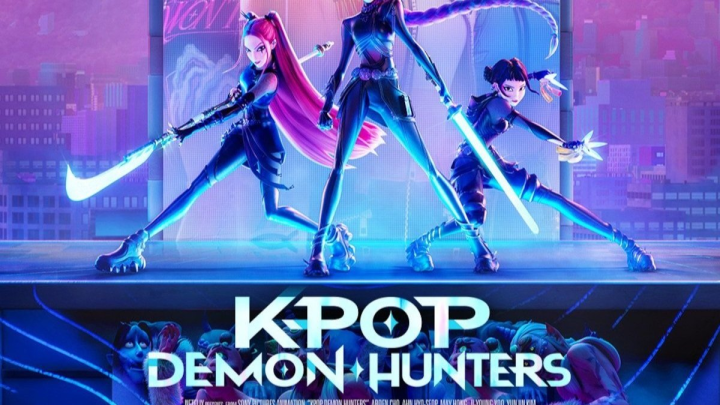
Hello and welcome back to HallyuTones – always focused on sound, stage and substance.
For our first ever review, we decided to take a look at a new Netflix movie that is taking the world by storm. ‘KPop Demon Hunters’ is the latest animated movie from Sony Pictures Animation and published by Netflix. The film released on 20th June 2025 in all major territories.
(The following review contains spoilers for this film – I highly encourage you to watch this film yourself and share your own reviews in the comments below!)
I must admit that, at first, the premise of this movie had me concerned. The Kpop genre is often oversimplified or stereotyped in it’s portrayals in popular media. Flashy dance moves, bright coloured hair and squeaky clean vocals form a particular image in the eyes of most people who are only vaguely aware of the genre. It is not to say that these factors aren’t part of the presentation of many Kpop groups, but rather that this view of the genre is reductive and ignores the multiple facets of the industry.
However, this film immediately challenges these conceptions and changes things up through combining common perceptions of the genre with a central plot concerning demon hunting. Director Maggie Kang stated that this film was drawn upon her Korean heritage, pulling in aspects of mythology and traditional culture and blending them with Kpop to create something unique.
Plot
The central plot revolves around a mythical cycle. In feudal Korea, demons appeared, attacking villagers and feeding their souls to their Demon King, ‘Gwi-Ma’. This devastation ruined communities and terrorised the people, until three brave women stood up to change the tide. These demon hunters trained to fight back the demons, and used their unique musical abilities to create a barrier referred to as the ‘Honmoon’. Once this barrier was erected, the demons were temporarily unable to return to the human world.

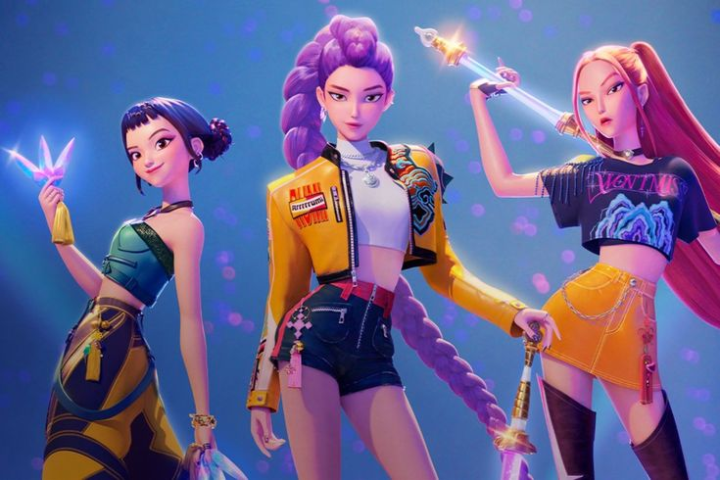
However, such magic is powerful and difficult to sustain. Therefore, each generation elected a new trio of powerful women to perform this sacred duty in order to maintain the Honmoon. This is how we are introduced to our current cast. The three members of the Kpop group HUNTRIX are the next selected guardians. Rumi (Arden Cho), Mira (May Hong), and Zoey (Ji-young Yoo) are well prepared to continue this legacy.
In typical Kpop fashion, the girls are shown to have developed a fervent fandom who are obsessed with every aspect of the girls’ personalities and performances. During their introduction, the girls are described through the lenses of their fans who dissect each of their unique quirks.
However, on the night of their final tour stop, their flight is intercepted by undercover demons. This leads to a really exciting first action scene, where the girls sing along to their song ‘How It’s Done’ as they skilfully dispatch the demons before landing on stage ready to perform.
Once the music starts, you can see how their performance immediately unites the fans, who scream and wave their light sticks in time with the music. With their popularity at an all time high, the girls truly seem on top of the world. But, like all artists, they need some rest and relaxation. While Mira and Zoey prepare to unwind, Rumi feels particularly inspired and decides to release their next single early. But disaster strikes when during the lead up to the performance, Rumi loses her voice.
It is at this point that the central plot thread unveils itself. On the rooftop, Rumi reveals that she has distinctive marks that identify her as part demon. Her flashbacks as she sings on the rooftop reveal that her mentor, Celine told her that the only way to rid herself of her heritage is to create the ‘Golden Honmoon’ – when all the demons are gone, her demon marks may finally disappear.

The demon realm however is still reeling from their recent loss. Gwi-Ma is exerting his fury when he is approached by one of his demons named Jinu. Instead of their traditional raids, he proposes that they create their own demon boy band to infiltrate the music scene and siphon souls to their lord.
Back in our world, the girls quite literally bump into this new boy band, who are all stylised in typical Kpop fashion. With rippling biceps, six packs and perfect hair, the girls are instantly enamoured in a scene that looks taken straight out of a K-Drama. Once the ‘Saja Boys’ start performing, the girls immediately become suspicious as they seem to instantly enchant the crowd with their debut single ‘Soda Pop’. After failing to stop them in a fight, Jinu identifies that Rumi shares his heritage.
Jinu reveals to Rumi that he became a demon in order to save his family. He was gifted a beautiful voice in exchange for his soul, which allowed him a high ranking position in court. However, when he was banished, he lost everything and became haunted by the guilt of his memories.
Conflict arises when Mira and Zoey formulate ideas of a song to stop the Saja Boys, with lyrics focusing on taking them down. Rumi is privately conflicted, feeling that the lyrics don’t match her hidden sentiments. She desperately seeks a way to redeem the demon world that will not result in violence.
Entering the third act, Rumi and Jinu are both emotionally torn. After a devastating demon attack, Rumi is caught between her perceived duty and her heritage. Jinu is similarly caught between his developing feelings with Rumi and the threats from Gwi-Ma that are forcing his hand. A beautiful duet, ‘Free’, between the two describes these mixed emotions.
This all comes to a head at the yearly Idol Awards, which are pitched as a neck-and-neck showdown between the two mega popular groups. When the Saja Boys don’t show, Huntrix are moved forward in the line up, where they perform their new song ‘Golden’. Mid-way through the performance, Rumi realises that this is all a ruse – her fellow bandmates Mira and Zoey have been replaced with demons.
The set list continues with their track ‘Takedown’, which draws out the demon side of Rumi in explosive fashion. Traumatised, she runs off stage and hides. The other members, upon seeing her true form, are terrified. She confronts Jinu, who then reveals everything was a lie.
As the Saja Boys perform their song, ‘Your Idol’ the crowd become hypnotised by their stage, and the Honmoon is disrupted. Lyrics sing about the group being their idols and how their fans will always follow them, as the crowd enter an almost zombified state.
As the world is threatened, Rumi returns with resolve – she will fight back against the demons as her true self. Embracing her true appearance, she sings a defiant song about her own anxieties and shames, which reunites the group to fight back. In a critical moment, Rumi is injured, but Jinu finally gives in with a selfless gesture – he offers his soul to save her life. Freshly enlivened, the girls defeat the rest of the demons and restore the Honmoon.
The movie resolves with the girls reunited, Rumi showing her true self freely and embracing who she really is.
Music
With a film so strongly rooted in Kpop as it’s central premise, music is super important. Almost every key plot aspect in this film is accompanied by a musical number to great effect.
While many of the songs are predominately in English, Korean phrases are utilised to ensure that the songs still retain some Kpop roots. Furthermore, Teddy Park, acclaimed Kpop producer and CEO of THEBLACKLABEL, helped produce the songs ‘How It’s Done’ and ‘Golden’. With a reputation for instantly catchy and memorable hooks alongside sleek production, this really helps make both tracks stand out.
In addition to this, track ‘Takedown’ has two versions within the soundtrack. While one version is sung by the main cast, the other is performed by TWICE members Jeongyeon, Jihyo and Chaeyoung (with the film even ending with a behind the scenes clip of the production of the song). This song expertly showcases the skills of the members, seamlessly flowing between high notes and frenetic rap sections.
However, the main cast also have accumulated a lot of music accolades. Rumi’s singing voice is provided by EJAE, a songwriter who produced the English demos for hit Kpop songs like Red Velvet’s ‘Psycho’, Aespa’s ‘Armageddon’, and NMIXX’s ‘O.O’ and ‘Dice’.
Mira’s singing voice is provided by Audrey Nuna, a Pop/R&B artist under Sony Music Entertainment best known for her songs ‘Damn Right’ and ‘Comic Sans (featuring Jack Harlow)’.
Rei Ami provides the singing voice of Zoey. She is an Alternative artist who blends many genres in her work. She gained notoriety featuring in the song ‘FREAK’ by Sub Urban which became a hit song on TikTok.
By comparison, Jinu’s singing voice was provided by Andrew Choi – after ranking high in SBS’s ‘Kpop-Star Season 2’ he became a composer for many groups. His credits include songs like VIXX’s ‘After Dark’, NCT 127’s ‘Whiplash’, NCT Ten’s ‘Dream In A Dream’ and Pentagon’s ‘Asteroid’ among others.
With such a wide range of experienced producers, songwriters, composers and rising vocalists, it’s no surprise that the musical elements of this film landed so well. ‘Takedown’ ‘s high tempo and brutal raps contrast well with the sweet dance bop ‘Soda Pop’ which brings to mind groups like ASTRO and BTS.
‘Golden’ is the definite standout, a grand pop piece that is instantly catchy, bringing a similar energy as Kpop smash hit song ‘I Am’ by IVE. ‘Your Idol’ is a dark song that critiques Kpop fan culture with it’s lyrics, daring to ask the audience the dangers of blind fanaticism, dressed in loud bass and deep vocals.
Even outside of the original songs, there are many nods to Kpop acts past and present. Anearly film montage showing the singers through the ages showcases a range of fashion styles that may be call backs to each generation of Kpop, including a deep cut to ‘The Kim Sisters’ (widely established as one of the first ever Kpop acts).
Messages in the background of scenes reference TWICE and newcomer MEOVV. TWICE’s ‘Strategy’ plays in one scene, while SUPER JUNIOR’s ‘Black Suit’ instrumental plays in another. Finally, the song ‘Love, Maybe’ by Melomance plays during the K-Drama style scene when the two groups meet. This is particularly apt, as this was used in the OST of drama ‘Business Proposal’. The voice actor for Jinu (Ahn Hyo Seop) was a main actor in this show, so it is a clever reference to his previous work.
Animation and Inspiration
Whether you have watched this film, or simply seen a trailer or a short clip, it is immediately apparent that this movie is gorgeous. While Sony Pictures Animation have seen huge success in recent years with the ‘SpiderVerse’ movies, which blend multiple 2D art styles to great effect, director Maggie Kang wanted a different approach.
The movie opts for a more 3D style but with clever creative angles to give a pseudo-2D effect. Dance moves and action poses are accentuated and stretched to bring more drama to the scene.

Of particular note are the use of ‘Chibi’ style facial expressions. Instead of a squeaky clean, perfect visual, the members are seen wailing with tears literally streaming down, or scrunching their faces in unnatural ways. This lends an additional layer of humour to the scenes, with a clear influence of both anime, and arguably popular Korean chat service emoticon that often show exaggerated expression.
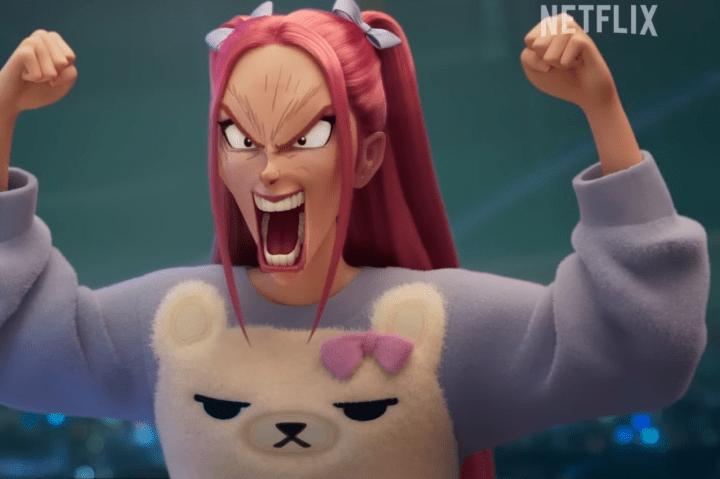
Stylistically, the film drew deeply on both contemporary and traditional Korean culture. Seoul is presented as a vibrant and modern city filled with giant skyscrapers and billboards filled with bright lights. Shots are deliberately set up to mimic Korean music shows with panning cameras and close-up face shots during key moments. Romantic scenes show slow pans and jump cuts that deliberately evoke a romantic K-Drama.
Character designs draw direct inspiration from current active groups that the creative team enjoy. The Huntrix members wear similar stage outfits to groups like TWICE and AESPA, with their appearances mirroring artists like ITZY’s Yeji and BLACKPINK’s Jennie. Conversely, the members of the Saja Boys are clearly inspired by famous Korean celebrities like Cha Eunwoo, BTS’ Jimin, and ATEEZ’s San among others.

The film also draws stylistically from traditional Korean culture. Characters in the flashback scenes where traditional Korean clothing like Hanboks, while the Saja Boys don ‘Gat’ hats (a wide brimmed hat popular during the Joseon period). The demons in their ‘true’ forms are designed after their appearances in traditional Korean artwork, complete with bright colours and strange facial expressions.
The demon cat is a particularly noteworthy and striking design. It’s facial expression echo’s the Cheshire Cat, with the mannerisms of a Studio Ghibli supporting character (as it charmingly bumbles about in most scenes). Symbolically, cats have a rich history in traditional Korean culture as messengers or intermediaries between the human and spirit worlds. In the film, it is seen stepping in between the realms through portals.

On the other hand, the ancient ‘Yagwanggwi’ was seen as a more malign entity, a demonic cat that left it’s mark in unguarded shoes. Once these were stepped into, it case curses on the unsuspecting. In this way the scary appearance of the cat also echoes these traditional fears. While it ultimately does not serve as a threat, it reinforces one of the central messages of the film to not judge others by their appearance.
Message and Influence
This film could easily have been 90 minutes of songs broken up by intermittent action scenes. These elements are both present, but fortunately are supported by a pervasive message.
It is important to note that as an all ages animated film on Netflix, the audience for this film may skew even younger than your average Kpop fan. As is typical for many animated movies, the main character, Rumi goes on a journey of self-discovery and acceptance.
As an audience we are introduced to the demons as terrifying otherworldly entities intent on destruction, absorbing the souls of all mortals they encounter. Without a disguise, they appear huge and monstrous, displaying animalistic behaviours accompanied by fangs and sharp claws. This imagery instantly creates a perception of them as evil and a malign influence.
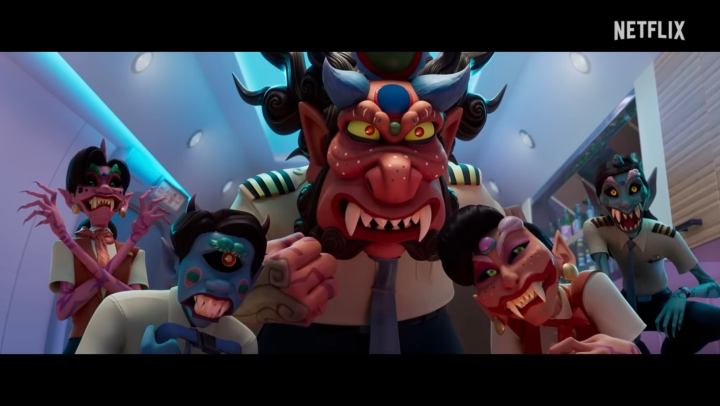
Contrary to this, the visuals of Huntrix are (to their fans) perfect and pristine, instantly creating echoes to the popular Kpop idol culture. When it is revealed that Rumi is part demon, this is shown through deep colourful lines on her skin that she is forced to cover in order to not betray her image.
With the introduction of Jinu (another ‘perfect’ appearing character who secretly is a demon), Rumi becomes conflicted. Her developing feelings for Jinu put her at a crossroads between two worlds. She is drawn between duty and authenticity. In fully fulfilling her given role, she runs risk of betraying herself. This manifests in the loss of her voice. While the other members labour over the new song, she cannot come to terms with writing about destruction when she already feels so conflicted.
By the climax of the movie, when her secret is revealed, the instant shock is apparent on her member’s faces. Instead of trusting their friend, they immediately feel betrayed and lied to. They see her as a threat and antagonistic to their given role. It is only when Rumi consolidates both aspects of herself to make the right choice at the end of the movie, that two key things happen.

Firstly, as she embraces herself, the audience break out of their stupor and support her. Her authenticity is clear even to those who don’t know her personally, her actions breaking down negative stereotypes.
Secondly, it is only when she incorporates both sides and witnesses Jinu’s sacrifice that she becomes whole. Many of us hide parts of ourselves away out of shame. We harbour our past guilts, letting them weigh on us through sleepless nights instead of talking to others. We constantly seek approval, a positive image and acceptance. But true acceptance has to come from within.
In the end, the only person truly holding Rumi back was herself. Her inner monologue, alongside her learned experience fostered a deep rooted self-hatred that she struggled to claw her way out of. But by truly coming face to face with herself she broke down those barriers and became a better person because of it.
Conclusion
‘KPop Demon Hunters’ is a great movie. It is well-paced, beautifully animated and entertaining. The humour lands well, and action scenes are dynamic and exciting. The songs are also top notch, sticking in your head as well as any chart topping Kpop smash hit.
The central plot, while simple, works well, with an underlying message that everyone would do good to remember – be yourself, face your worries, and be authentic.
I felt that at times Mira and Zoey were underutilised. Mira’s lack of self-worth stemming from her family is mentioned, but not built upon. Zoey feels insecure and at times immature, but her story is often utilised as part of running gags rather than holding substantial weight. In addition, the demon plotline was resolved well, but I would have liked to see an acknowledgement that the demons can co-exist with humans without destruction.
Overall, as a Kpop fan, an animated movie fan and as someone who has consistently struggled with self-image, this film was very powerful for me. I find star ratings reductive, but I would recommend this to anyone who wants a great short film to watch. Of course, Kpop fans will get the most out of this one, but I feel that the film explains itself well enough that anyone could comfortably follow along.
Have you watched ‘KPop Demon Hunters’ on Netflix? What are your thoughts? Are there any other Korean music releases that you’d like me to review? Leave them in the comments section below!
 HallyuTones
Leave a comment